Turkey's carrot production, the geographic-indication status behind Beypazarı carrot candy, the UNECE quality standard, and post-harvest storage risks.
According to TÜİK (Turkish Statistical Institute) data, Turkey's carrot production hit a record of roughly 898,000 tons in 2024. Most of that volume grows in the deep, loamy soil of the Konya plain, while the carrot's second identity comes from the Beypazarı district of Ankara — a chalky, calcareous soil and karstic spring water give the region's carrot a distinctively sweet, aromatic character. Beypazarı's reputation runs deep enough that Beypazarı Havuç Lokumu, a confectionery paste made from this carrot, holds a geographic-indication registration (mahreç işareti) with TÜRKPATENT — filed in 2019 and registered in 2022.
A new season opens in September
Carrot is a root vegetable sown in spring and harvested in autumn; the Nantes type peaks with the autumn harvest in September, while the highland Beypazarı carrot runs its own harvest through the same month — see our September harvest guide for how this fits alongside the rest of the calendar. Once cleared of soil residue, carrot can hold in cold storage for months, making it one of the few root vegetables reliably supplied into winter.
Quality classification
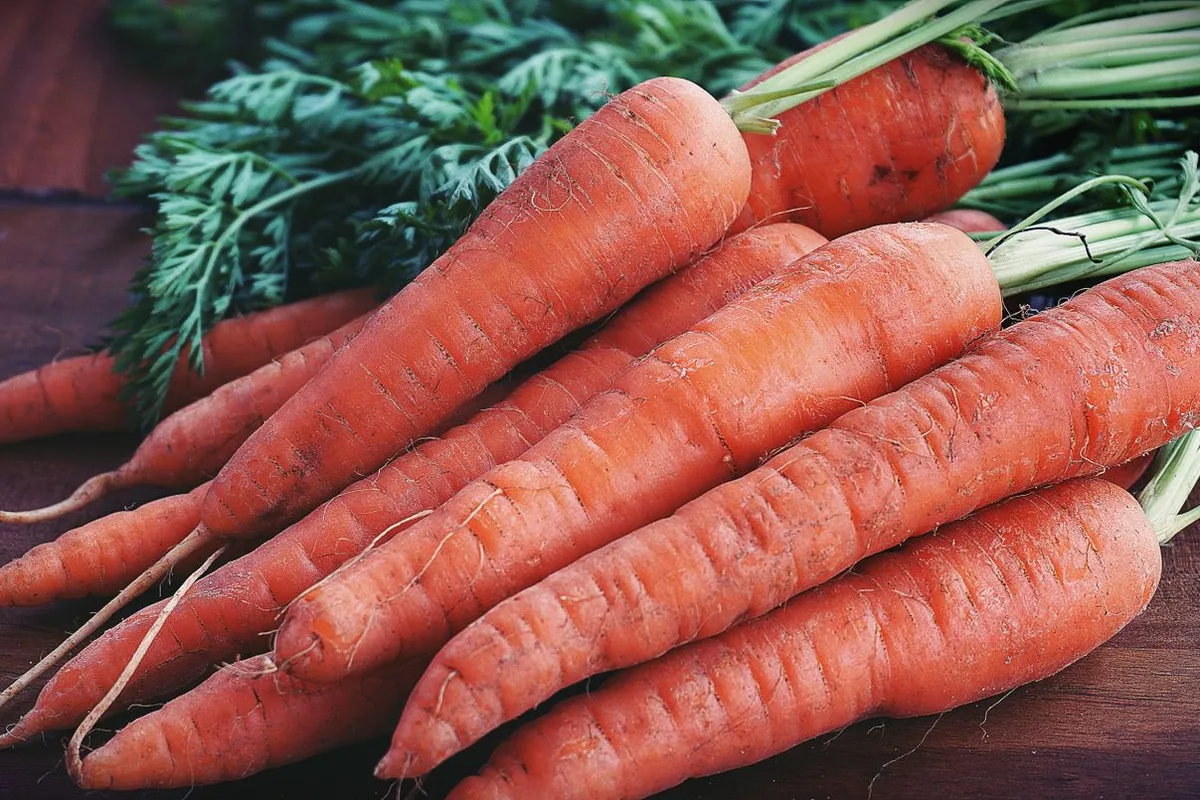
Carrot ships in three quality classes — Extra, Class I, and Class II — under grading that mirrors UNECE's carrot marketing standard (FFV-10), calibrated by diameter. In our own supply we separate three caliber groups: a fine/baby caliber of 15-25 mm, a standard caliber of 25-40 mm, and a thick/industrial caliber above 40 mm — full detail is on our carrot product page. Export-grade roots should show a smooth cylindrical form, a crack-free surface, and no green shoulder (sun-exposed discoloration at the crown).
What visual inspection catches
The most common quality issues are cracking, forking (irregular, multi-pronged root growth), and green shoulder; sprouting after harvest, when the root pushes new growth, also shortens shelf life. The main risks for moisture loss and microbial spoilage are gray mold and soft rot, which is why rapid post-harvest cooling and stable humidity are decisive for holding quality. Alongside domestic supply, the Middle East stands out as a leading direction for carrot exports, largely due to geographic proximity.
A storage risk that is easy to overlook: ethylene
Temperature is not the only variable that matters in carrot storage — ethylene sensitivity is just as important. Exposure to even a low concentration of ethylene (around 0.5 ppm) for about two weeks can turn carrot bitter, which is why it should never share cold storage with ethylene-producing fruit such as apple or pear. Under the right conditions — 0-1°C and high humidity — washed, topped carrot can stay fresh for months; see our cold chain guide for the broader logic behind that discipline.
Packaging: from bulk to retail shelf
Packaging follows demand across three formats: 5-25 kg mesh sacks for wholesale shipment, small 2-3 kg retail mesh bags ready for the supermarket shelf, and double-wall corrugated 10/20 kg cartons, a common export alternative. Carrot has broad use in Turkish cooking, both raw — grated into salads, tarator, and olive-oil dishes — and cooked; Beypazarı carrot, with its higher sugar content and aroma, is especially favored for fresh-pressed juice.
For current harvest and supply status, see our Seasonal Calendar; for variety and packaging detail, our carrot product page; and for our other root and leafy vegetables, our vegetable export guide.
Frequently Asked Questions
Does Beypazarı carrot hold a geographic indication?
Not the raw carrot itself — Beypazarı Havuç Lokumu, a confectionery paste made from it, holds a geographic-indication (mahreç işareti) registration with TÜRKPATENT; the application was filed in 2019 and registered in 2022.
Why should carrot not be stored with certain other produce?
Carrot is highly sensitive to ethylene; exposure to a low concentration (around 0.5 ppm) for about two weeks can make it bitter. For that reason it should not share cold storage with ethylene-producing fruit such as apple or pear.
Why does September matter for carrot?
September is when the Nantes-type carrot reaches its peak with the autumn harvest and becomes suitable for cold storage through winter — making carrot one of the few root vegetables that can be supplied reliably toward year-end.