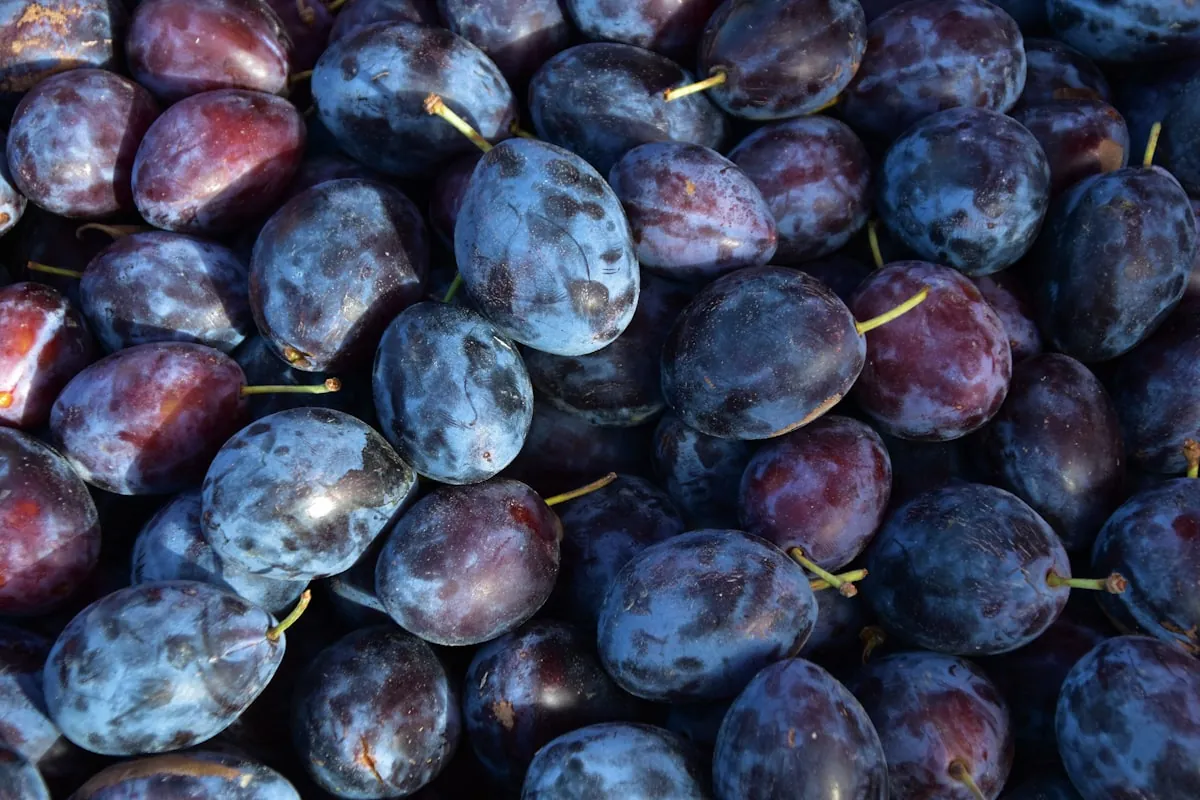
Turkey's plum production, the export-oriented Japanese plum varieties, and how they differ from domestic-market cultivars.
Turkey is the world's 5th-largest plum producer, according to FAOSTAT data, ranking behind China, Romania, Serbia and Chile, and ahead of Iran. According to sector sources, production reached roughly 355,000 tons in 2023 and a historic peak of about 376,000 tons in 2024, before falling to around 227,000 tons in 2025, largely due to adverse weather.
Two different plum worlds: export and domestic
Talking about Turkish plum really means talking about two quite different variety groups. Japanese plum (Prunus salicina) cultivars such as Black Amber, Angeleno, Friar, Fortune, Formosa and Black Diamond — large, firm-fleshed and long-shelf-life — are grown mainly in the Aegean and Mediterranean regions specifically for export. Their firmness makes them well suited to long-distance shipping.
On the other side are the so-called "Can group" varieties — Can Eriği, Papaz Eriği (President), Mürdüm Eriği (Bardak Eriği), Türbe Eriği, Şeker Eriği and Üryani Eriği — small, soft-fleshed, short-shelf-life fruit grown mostly for domestic fresh consumption and for drying/processing. These tend to be tart or eaten before full ripeness, and cater to regional taste preferences.
Growing regions and harvest calendar
Plum production concentrates in the Aegean (İzmir, Manisa), Marmara (Bursa, Çanakkale), Mediterranean and Isparta regions; the export-oriented Japanese plum varieties are grown mainly in the Aegean and Mediterranean. Harvest opens in June with early, sweet red varieties in the Aegean and Marmara, peaks in July across Central Anatolia and Black Sea highland areas, and continues through August-September with late-season and drying/processing varieties — giving plum a continuous supply window across the summer.
A young category in exports
Turkey's export share in plum does not match its production volume: according to international trade data, Turkey does not rank among the world's top 10 fresh plum exporters (a list led by Chile, Spain, Hong Kong, South Africa and China) — most of the crop is consumed domestically. Exports from early/greenhouse-growing areas such as Silifke go largely to Europe and Arab countries.
What quality control actually looks at
Plum firmness is measured with an 8 mm tip penetrometer; "ready-to-eat" texture is roughly 2-3 lbf (~10N), and fruit softens at 0.42-0.55 N per day at 20°C — which is why timing matters so much in plum. Pre-cooling speed is especially decisive: fruit rapidly cooled below 4°C, ideally to 0°C, retains 39.4% more firmness after impact than fruit bruised before cooling. Stored at 0°C and 90-95% humidity, plums can hold for 3-6 weeks depending on cultivar — though fruit held too long even at that temperature can develop chilling injury (flesh browning, "bleeding," abnormal ripening), so getting the temperature right is not enough on its own; duration has to be managed too.
Buyers also check the plum's natural wax coating (bloom) — it signals resistance to moisture loss, and rubbing it off in handling reads as reduced visual quality; as little as 5% weight loss can produce visible shrivel. The firmness of export-oriented Japanese plum varieties (Black Amber, Angeleno and similar) gives them a clear edge over domestic varieties in meeting these tolerances.
MC Sarıkaya Gıda supplies nine plum varieties — Şeker Eriği, Can Eriği, Türbe Eriği, Mürdüm Eriği, President, Black Amber, Angeleno, Papaz Eriği and Üryani Eriği — all quality-checked before shipping. Visit our plum product page for full variety and season details.
Frequently Asked Questions
Where does Turkey rank in global plum production?
According to FAOSTAT data, Turkey is the world's 5th-largest plum producer, behind China, Romania, Serbia and Chile.
Which plum varieties are suited for export?
Large, firm-fleshed Japanese plum (Prunus salicina) varieties such as Black Amber, Angeleno, Friar, Fortune, Formosa and Black Diamond are export-oriented, while small, soft-fleshed varieties like Can Eriği, Papaz Eriği and Mürdüm Eriği go mostly to the domestic market.
When is Turkey's plum harvest season?
Harvest opens in June with early varieties in the Aegean and Marmara, peaks in July, and continues through August-September with late-season and drying/processing varieties.
What do plum buyers actually check on arrival?
Firmness measured by penetrometer (ready-to-eat is roughly 2-3 lbf), an intact natural wax coating (bloom), and shrivel from weight loss.