Turkey's fast-growing, though not world-leading, persimmon production, its shift toward the Mediterranean, and astringent vs. non-astringent handling.
World persimmon production is shaped overwhelmingly by China, which alone accounts for more than 75% of the global harvest. Turkey is not the world leader here, but it has a real, fast growth story in the academic literature: according to ISHS (the International Society for Horticultural Science), Turkey's production rose from roughly 26,300 tons in 2010 to roughly 60,700 tons in 2020 — a 2.3-fold increase over the decade. TÜİK data show the growth continued, with 2022 production at around 97,500 tons and 2024 output near 142,000 tons.
Production weight shifting from the Black Sea to the Mediterranean
Although the fruit takes its name from Trabzon on the Black Sea coast, production weight today has shifted heavily toward the Mediterranean. Per academic sources, the Mediterranean region (Hatay, Adana, Mersin, Kahramanmaraş) accounts for roughly 44% of national production, Adana alone holding the largest single-province share. That shift is reflected in our own supply regions: Adana, Mersin, Hatay, Sakarya, Adıyaman, and Denizli.
Astringent and non-astringent: two handling regimes
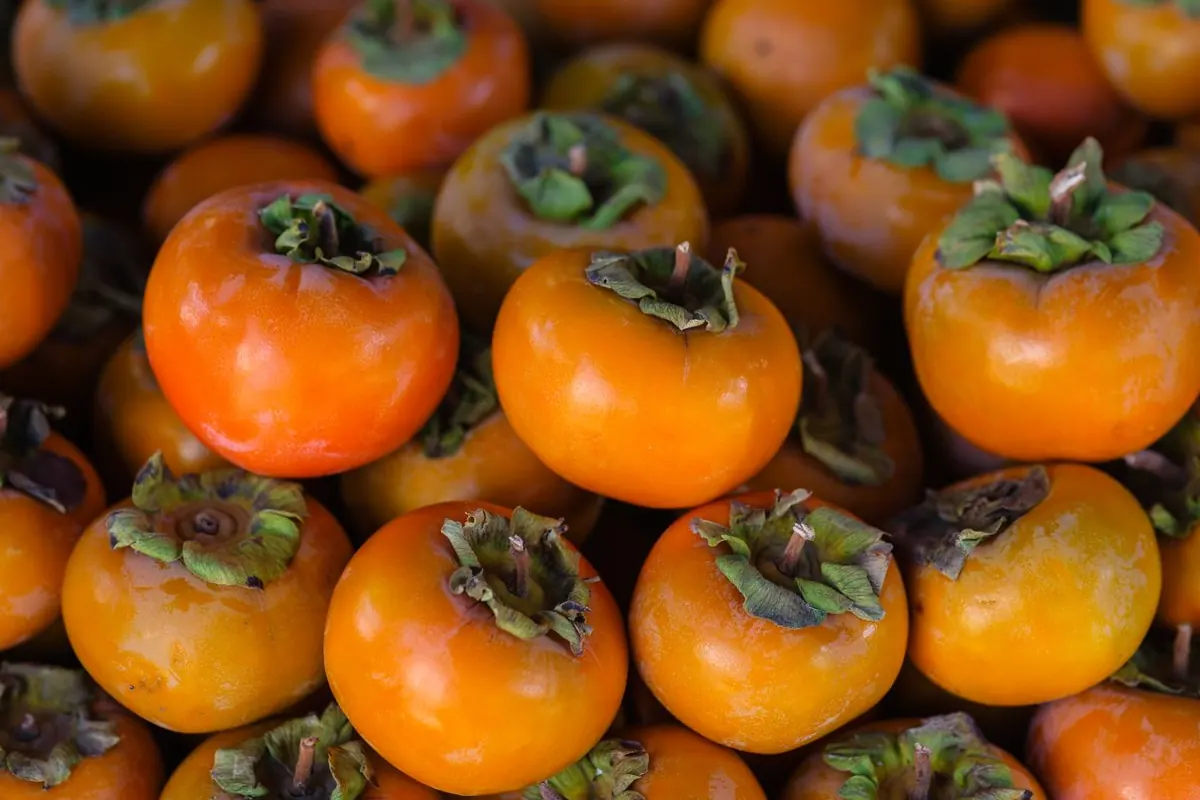
Persimmon comes in two handling types. Astringent, Hachiya-type varieties do not become edible until fully softened, owing to their tannin content; non-astringent, Fuyu-type varieties can be eaten firm, much like an apple. Commercially, astringency is removed using controlled ethylene (10 ppm at 20°C) or CO2 (80% for 24 hours at 20°C) — the CO2 method preserves firmness better. Non-astringent types are more prone to chilling injury (flesh softening, browning) in the 5-15°C range, a risk that worsens with ethylene exposure.
Quality classification
In line with the UNECE marketing standard for persimmon (FFV-63), adopted in 2015, fruit ships in three quality classes — Extra, Class I, and Class II — calibrated by weight; the full caliber table is on our persimmon product page. Under the right conditions (0-1°C), fruit holds up to 3 months in ethylene-free air, or 5 months under controlled atmosphere.
For current harvest and supply status, see our Seasonal Calendar; for variety and packaging detail, our persimmon product page; and for the export process, our Export page.
Frequently Asked Questions
Is Turkey the world's largest persimmon producer?
No. China alone accounts for more than 75% of world persimmon production. Turkey's own production is growing quickly, however: according to ISHS data, it increased 2.3-fold between 2010 and 2020.
What is the difference between Fuyu and Hachiya persimmon?
Fuyu is a non-astringent variety that can be eaten firm, much like an apple; Hachiya is an astringent variety that, owing to its tannin content, does not become edible until it has fully softened.
Why is persimmon production no longer concentrated mainly on the Black Sea?
Although the fruit takes its name from Trabzon on the Black Sea coast, production weight has shifted over time toward the Mediterranean region, particularly Hatay and Adana, which today account for a significant share of national production.